SELECTED
RESOURCES

amazon.ca
amazon.co.jp
amazon.co.uk
amazon.com.au
amazon.com.br
amazon.co.mx
amazon.de
amazon.es
amazon.in
amazon.it
amazon.nl
amazon.fr
amazon.at
amazon.pl
































Credo [ Hymn ]
coro a cappella: SATB; BB
soloists: Soprano, Tenor, Basso
/ measure: 293 /
27 May 2006, Sunday - 27 May 2006, Saturday
/ villa "Lina", v.Emona, Bulgaria /
back to works
Please see a small part of this work in printed form [PDF version]. While performing in a Christian church, not due to a copyright fees. The same goes for concert performance for charity! For more information please contact us.
In a possible interest in the work, please contact us through our e-mail.
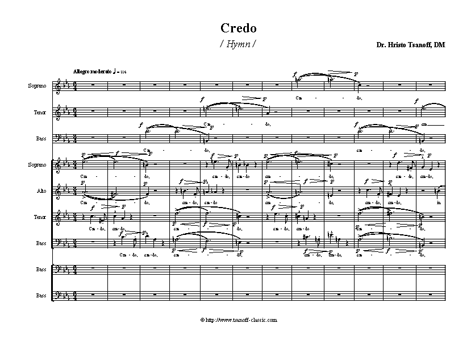
Hristo Spasov Tsanoff: Credo (2006) for STB soloists, SATB and BarB unaccompanied choruses comments by Peter Fawcett based on a reading of the manuscript score.
The Nicene/Constantinopolitan Creed dates from the 4th century A.D. and for the majority of Christians it forms the quintessential expression of their faith. This Creed is referred to by Roman Catholic and Orthodox Christians as the "symbol of faith", and its recitation is often part of Christian worship services. In the Roman Catholic church the creed is the longest part of the 'ordinary' of the Eucharistic liturgy (Mass).
It is worth noting that originally the creed was expressed in the plural - credimus - as a corporate statement of doctrine, but was later changed into the personal expression of faith. In the late 20th century the plural, corporate, form was readopted by many sects, including the Roman Catholics. There are many hundreds of musical settings of the Mass and, because of its length, the creed has often received fairly simple treatment in these settings. Considering its religious importance one would have expected much attention from composers as a stand-alone text; but this has not been the case. There is a handful of Baroque settings (including Bach, Boccherini, Cherubini, Martini and Vivaldi), a few 19th-century (including Gretchaninov and Puccini) and a few more recent ones, such as Healey Willan and Rautavaara.
It is good, therefore, that Dr Tsanoff has chosen to add to the number of stand-alone 'Credo' settings.
The text The text affirms the Trinity - Father, Son and Holy Spirit - and falls naturally into three parts. For purposes of comment I identify them thus:
1.
God the Father
concise and unequivocal statement.
2.
Christ, Son and Lord
this is the longest part.
2.1.
Christ's relationship to God;
2.2.
His Nativity,
2.3.
His Crucifixion;
2.4.
His Resurrection and Ascension;
2.5.
His Second Coming.
3.
The Holy Spirit
3.1.
relationship to Father and Son and witness in Prophesy;
3.2.
the Apostolic church;
3.3.
remission through Baptism;
3.4.
salvation and everlasting life.
The distinction between a corporate and a personal interpretation of the creed is bound to influence a composer's approach. With the latter, and with non-liturgical performance in view, there can be greater freedom in how the text is treated. One does feel, however, that the structure of the text should inform a choral setting.
Part One of the text is definitive and didactic; Part Two begins definitive but continues as narrative, ending with prophesy; and Part Three proclaims the affirmation of the spirituality of man, of belief, and of the Christian faith.
Tsanoff takes measures to heighten the significance of the text, as he reads it, with devices such as: repetiton of words; repetiton of phrases; overlap of text between one part (or section) and another; and use of these devices in threes or at the word passus in threes and sixes. Especially, the key word Credo is present throughout Part 1, through much of 2.1 and 2.2 (?)1, as a coda to 2.3 and into 2.4, and in much of 3.4. Repetitions, overlaps and three-groups are used to heighten this declamation and in places declamation of the word is used as a pedal to the musical texture. Overall, however, one does not sense the essentially different characters of the definitive, narrative and affirmative parts of the text.
COMPOSITIONAL DEVICESThe work begins in triple time which continues through 2.1 and 2.2 until bar #160, where et incarnatus est is marked with duple time and this continues through 2.3 . Is this intended to represent Christ's stay on earth? After a reprise of Credo in triple time, the Ascension and Second Coming (2.5) are conveyed in common time; this continues into Part 3 until ..... mortuorum after which triple time resumes (over Credo pedal) for the remainder. No obvious alignment with the text, therefore.
Part 1 is characterised by canon in several ways and by some counterpoint. Part 2 begins with block harmony but develops counterpoint, continuing in 2.2. In 2.3 the texture is light, mainly single solo voices in sequence, with chorus comment in block harmony. In 2.4 the contrapuntal figures of Part 1 are reinterpreted. 2.5 reflects the character of 2.2, and 3.1-3.3 that of 2.1. The concluding section (3.4) uses elements of all the foregoing, so that the rhythmic structure is quite clear.
The harmonic language is largely atonal and this makes the work accessible only for skilled singers. There is an implicit E-flat/A-flat tonal focus, with pedal on the dominant, but the writing is highly chromatic. In 2.3 (Crucifixus) there is a shift of focus to E/A tonality. At the move to common time the centre reverts to A-flat, then to E-flat in 3.4 and the work ends on an uneasy first inversion of E-flat minor. Let me suggest that the harmonic scheme is not obviously related to the structure of the text.
MUSICAL IDIOMThe idiom is expressive and dramatic. The vocal resources (STB soloists, SATB and BarB unaccompanied choruses) are employed in many combinations. These variations in chora?/vocal texture are used to good effect alongside the contrapuntal devices mentioned above. The underlay of words and phrasing is practical. The role of the BarB chorus is interesting. It is introduced #31 as a pedal to the harmonic structure and holding the credo keyword - very powerful. It is then reintroduced as the leading component in Part 3 (affirmation) declaiming in two-part harmony, mirrored by the main chorus in four parts, and progressing to the reprise of the credo pedal on the dominant, firstly beneath florid lines from the soloists, then the main chorus, for et vitam venturi seculi . Perhaps the BarB chorus could have been allowed to be in at the end by resolving the harmony, and the work, with a fortissimo E-flat tonic!
IN CONCLUSINThese comments have been made by way of constructive criticism, and in admiration of Dr Tsanoff's labours. It has been my privilege, as a non-professional, to appraise the work. A fully-professional choir might enjoy the challenges of this setting and I wish Dr Tsanoff success in seeking a performance.
Peter Fawcett,
Hobart, Tasmania, Australia
January 2007
LAST WORKS: